


This chapter explains the molding (part) shrinkage rate, draft angle and flow path ratio that need to be considered when determining part dimensions.
Part Shrinkage Rate
Molding (part) shrinkage develops due to heat and pressure during molding. The shrinkage rate varies among each molding material depending on the size or condition of the parts.
Crystalline plastics has a higher and varied shrinkage rate than amorphous plastics. The higher crystalline plastics rate is due to the higher internal contraction; it is caused by the considerable volume decrease on change from liquid phase into solid phase.
A material containing filler such as glass fiber has a lower shrinkage rate and a smaller range of variation, so it is appropriate for applications requiring precise dimensions.
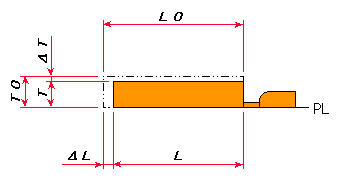 Assuming the molding shrinkage is a, and the manufacturing dimensions of the mold are L0 and T0, the amount of the contraction is obtained as follows:
DL= α*L0
DT= α*T0
Each material has its own fixed value of α
The chart below shows the molding shrinkage for each material:
|
Molding Shrinkage
(%) |
|
Polyethylene (PE) |
1.5-6.0 |
Polypropylene (PP) |
1.0-3.0 |
Polyvinyl chloride (PVC) |
0.1-0.5 |
Polystyrene (PS) |
0.2-0.6 |
Polycarbonate (PC) |
0.5-0.8 |
Acrylonitrile butadienstylene (ABS) |
0.3-0.8 |
Polyamide (PA) |
0.6-2.0 |
Daft Angle
The draft angle is the angle necessary for removing the parts from the mold. It is usually 1-2, but is determined by the material, the dimension of the parts, and texture treatment (making the surface of the part rougher).
Generally, the angle at the cavity side is set as small as possible, and the angle at the core set larger.
Crystalline plastics has a higher molding shrinkage rate. Therefore, at the cavity side, it is easy to remove from the mold since it shrinks toward inside of the mold. On the other hand, at core side, the part is hard to remove as it tends to adhere to the mold. Setting the draft angle should be done carefully so that the part will not stick to the core.
Amorphous plastics has a lower molding shrinkage rate and it does not shrink inward the mold. Therefore, the draft angle at the cavity side should be set as large as the core side angle.
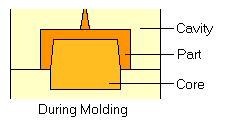
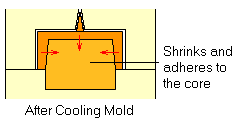
Molten plastics is filled up in the cavity. After cooling and solidifying, the molding shrinkage occurs. Because the part shrinks inward and adhere to the core, it is difficult to remove the part.
Flow Path Ratio
Flow path ratio is the ratio between L (the distance between the gate and the farthest point in the molding dimension) and T (the thickness of the part) .
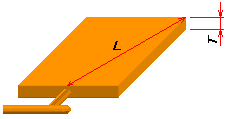
Hệ số dòng chảy = L/T
When molding large or thin parts, the flow path ratio is calculated to determine if molten plastics can fill the mold cavity.
Each molding material has its own flow path ratio, but the ratio varies to a large extent depending on conditions such as composition, temperature of the molten plastics, injection pressure, gate type, length of runner, and so on.
The table below indicates the target value for each material. A flow path ratio multiplied by the part thickness (T) becomes the distance of molten plastics flow (L).
[ L/T Flow path ratio target]
Resin Name |
Flow Path% |
Polyethylene (PE) |
L/T = 280-100 |
Polypropylene (PP) |
L/T = 280-150 |
Polyvinyl chloride (PVC) |
L/T = 280-70 |
Polystyrene (PS) |
L/T = 300-220 |
Polycarbonate (PC) |
L/T = 160-90 |
Acrylonitrile butadienstylene (ABS) |
L/T = 280-120 |
Polyamide (PA) |
L/T = 320-200 |