

You will learn about the necessity of degassing and air venting as well as their design.
What is degassing and air venting?
When molten plastics fills up the mold cavity, the air or molten plastics left in the mold will generate gas, which needs to be discharged out of the cavity. This process is called degassing and air venting.
If degassing and air venting are done incompletely, the following problems will happen:
– Due to inflow of molten plastics, the air in the mold will be compressed, and the compression heat raises the temperature of the molten plastics, causing a defective molding with discoloration or burn marks.
– If air ejection pressure is raised too high, a flash is likely to be generated on the parting line side due to air resistance in the mold.
– Due to the air resistance in the mold, short shot is likely to occur. Also, such defects in the molding such as weldlines or flow marks is likely to occur.
– The above problems can be solved by slowing the injection speed to some extent: However, since the mold temperature needs to be set higher, the molding cycle will be longer.
Design of degassing and air venting
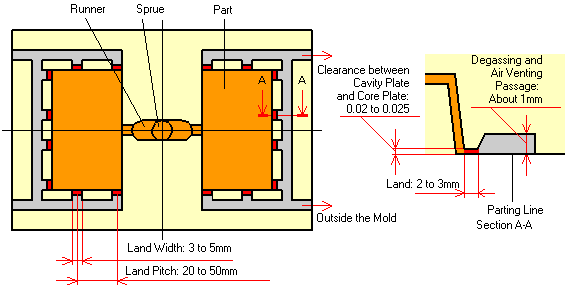
Degassing and air venting have to be through a narrow passage that allows air or gas, but not molten plastics, to escape.
Usually, the land (part to do degassing or air venting) is set to 3 to 5 mm in width and 20 to 50 mm in pitch as follows. It is considered desirable to take 0.02 to 0.025 mm of clearance for cavity plate and core plate, and have a pitch of 1 mm deep outside the mold.