

In this chapter, you will learn about items for consideration of mold dimension.
Mold Dimension
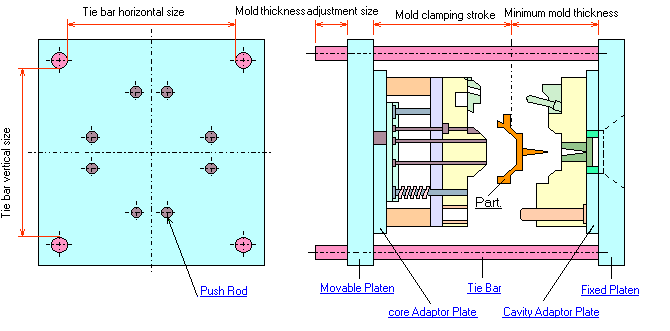
The dimension of a mold attached to the molding machine is determined by the shape of the relevant part or the ejection method, whereas there is a restriction by the tie bar distance or mold clamping stroke, which limits the mold dimension within the range.
The tie bar distance is set in accordance with a molding machine; therefore, vertical and horizontal dimensions of a mold are determined in consideration of the tie bar distance.
For the example shown in the figure below, the vertical and horizontal dimensions of the mold will be as follows:
– Vertical dimension of part should be less than vertical size of tie bar and horizontal dimension of part should be less than horizontal size of tie bar
– Vertical dimension of part should be less than vertical size of cavity plate and core plate and horizontal dimension of part should be less than horizontal size of tie bar
– Vertical dimension of part should be less than vertical size of tie bar and horizontal dimension of part should be less than horizontal size of cavity plate and core plate.
Straight Hydraulic Type
Since mold clamping stroke is predetermined for each molding machine, the minimum and maximum thickness of a mold is determined in consideration of the stroke.
For straight hydraulic method, as daylight (mold clamping stroke + minimum mold thickness) is kept constant, the mold thickness determines the mold clamping stroke.
- Set the minimum thickness of a mold higher than the minimum mold thickness that is written in the manual of the molding machine. Daylight = maximum mold clamping stroke + minimum mold thickness
- Set the maximum thickness of a mold lower than the minimum mold thickness + mold thickness adjustment value. Daylight = minimum mold clamping stroke + maximum mold thickness
Toggle Type
Since mold clamping stroke is predetermined regardless of mold thickness, the mold thickness is adjusted by a mold thickness adjusting device that is installed into the mold clamping device.
For toggle type, the daylight is determined by the mold thickness.
More details
There are two types of mold clamping device: straight hydraulic type and toggle type.
As straight hydraulic type utilizes hydraulic cylinder, mold clamping is available anywhere within the stroke range.
On the other hand, since toggle type utilizes a mechanical device, mold clamping is only available at the maximum mold clamping stroke. Therefore, the mold clamping device has a mold pressure adjustment device.
Tie bar distance is regulated by Japanese Industrial Standard (JIS)
Vertical/Horizontal Standard Dimension[mm] |
Possibility of Part Removal
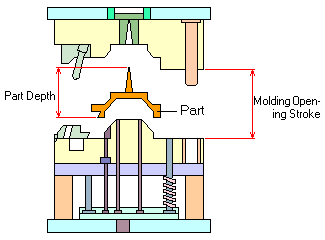
Confirm that a part can be removed from the mold without problems after considering the mold dimension.
If the maximum depth of a part exceeds half the molding opening stroke, then removal of the part is difficult. It is then necessary to consider the shape dimension of the sprue or runner, the mold structure, or the removal method of the part.
Ejector rod Position
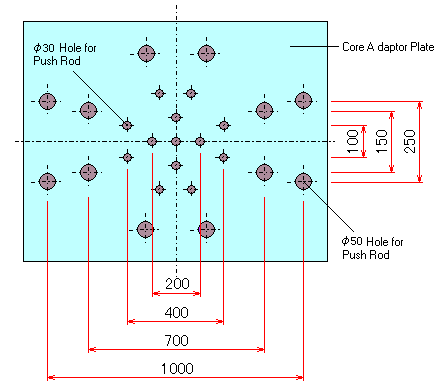
Check the position of the ejector rod of the molding machine and whether the mold installation position is proper. (Check the position of the ejector rod on the molding machine and the position of the clearance hole of the ejector rod on the core adaptor plate.)
The position of the hole for the ejector rod is regulated by Japanese Industrial Standard (JIS standard) as well as the hole diameter being Φ30 or Φ 50.