


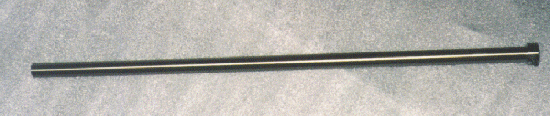
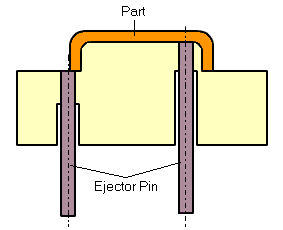
An ejector pin is connected to an ejector plate to eject parts out of a mold. It is necessary to carefully consider its position so that no fracture, warpage, or damage will occur to parts when removed. An ejector pin is easy to make, as well as to burn or polish, and can be placed anywhere on the parts. For these reason, it is widely used.
Parts are basically attached to a core plate in the mold opening.
This is because usually a cavity plate is located on the cavity side and a core plate is on the core side, strengthening the parts adhesion to the core due to mold shrinkage during cool-down of parts.
Generally, as molten plastics is injected from the cavity plate side, an ejector will be installed on the core plate side.
It is necessary to consider an ejection method or an ejector pin positioning in order to eject parts from the core plate without ruining their shape.
There are 6 types of ejection methods of parts.
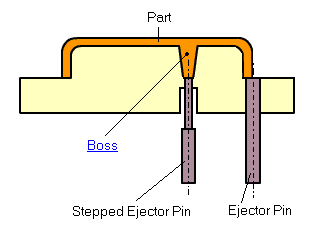
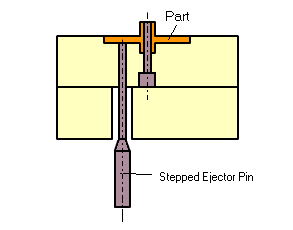
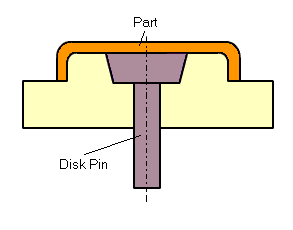
Pin Ejection

Sleeve Ejection
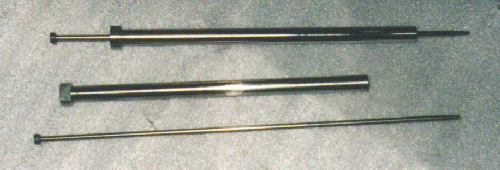
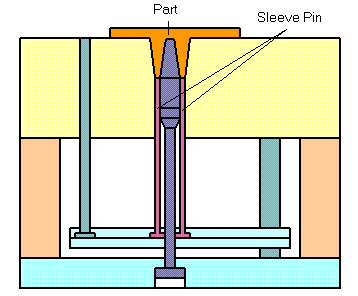
Easily processed. However, the type with a sleeve inner diameter either too short or long is difficult to process, whereas a thin type is likely to crack in use. On the other hand, release is made properly as it ejects evenly with the edge.

Stripper Plate Ejection
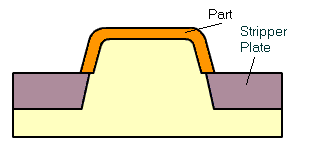
As stripper plate ejection has an advantage of a wide ejecting area compared with others, reliable removal is achieved even if ejecting resistance is high. At the same time, the appearance is better since no ejection trace is left.
Compressed Air Ejection
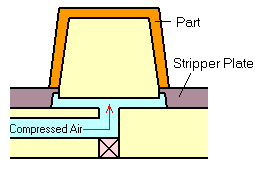
Compressed air ejection is often used to support the ejection of parts with a deep container (round shape) or to support stripper plate ejection to eject parts smoothly from a mold. This is because it effectively avoids generating a vacuum area between a mold core and a part during ejection. Also, unlike pin ejection, this method making removal by even pressure does not cause such defects as cracking or whitening to parts, nor deformation, even to a part with low deflection temperature under load.
Two-Stage Ejection
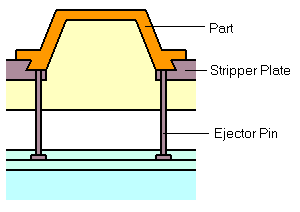
This method involves two steps of ejection of parts: usually combination of stripper plate ejection and pin ejection.
The procedure starts with stripper plate ejection to eject an entire part, and finishes with pin ejection to eject such areas as boss or undercut. It does not cause warpage, deformation, or cracking to parts.
Hydraulic Ejection
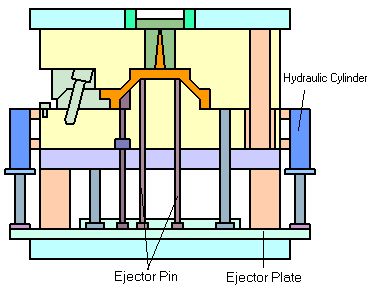
Hydraulic ejection uses an hydraulic device to eject parts. This method has many advantages, such as flexibility in setting of ejection timing or speed.
It is also used as a safety device to prevent an ejector pin edge from interfering with the mold by lowering hydraulic pressure or to avoid damaging the mold by stopping the process under an overloaded condition, such as the increase of ejector plate resistance.
You have learned about various types of ejector pins so far. Now, let’s look at the descriptions of ejector plates that are connected to an ejector pin.
Ejector Plate
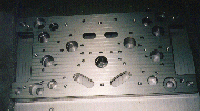
An ejector plate moves an ejector pin that ejects parts.
A push rod is pushed out of the molding machine to eject the ejector plate, by which the ejector pin pushes out parts.
A return pin is usually used to return the ejector plate to the original position. With this method, the edge of the return pin touches the surface of the cavity plate during mold closing and pushes back the ejector plate, but molding cycle is inclined to be longer.
A small mold often uses a return spring to return the ejector plate before mold closing after completing part ejection, which can shorten the molding cycle.
Weight Calculation Example
Weight calculation is originally supposed to be the total weight of all the parts attached to an ejector plate (return pin, push rod, loose core, slide unit). Here, we will simply calculate with the weight of an ejector plate.
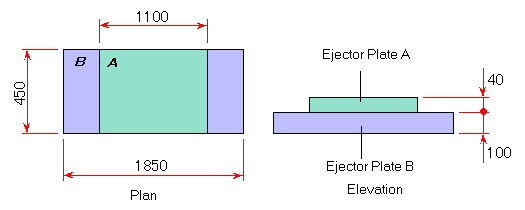
Weight of ejector plate A : 1100*450*40=19800000 =19800
19800*7.85 (Specific gravity of iron) =155430g=155.4kg.
Weight of ejector plate B : 1850*450*100=83250000=83250
83250*7.85 (Specific gravity of iron) =653512g=653.5kg.
Weight of ejector plate : W =A +B =155.4+653.5=808.9kg
Selecting Return Spring
Coild Spring
The selection of spring depends on the size of a mold. Here you will learn about relatively small molds and medium size molds.
For a small mold:
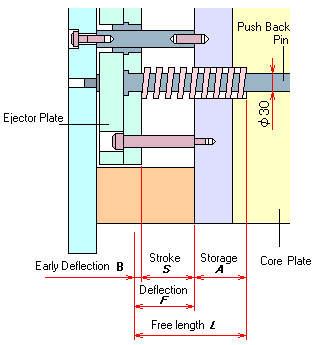
TLet’s take the stroke necessary to eject parts to be S =25mm This is the same distance as that from the top side of ejector plate to the bottom of core plate (the bottom side of support plate).
Spring storage depth = A
Spring early deflection = B
Spring deflection= F
Spring free length = L
Push back pin diameter = Φ 30
1. Confirming stroke
Stroke required to eject parts: S = 25mm
2. Selecting spring size.
Select outer diameter D = 46mm for srping size from catalog as return pin diameter = Φ30
3. Assuming a free length of spring
As stroke( S ) * 2 + a is common. assuming free length ( L )= 60mm and 70mm
4. Select SWR46-60, SWR46-70, SWS46-60, và SWS46-70 from catalog, and confirming deflection F.
| SWR46-60 | SWR46-70 | SWS46-60 | SWS46-70 | |
| Deflection ( F ) (mm) |
30 | 35 | 24 | 28 |
Explanation of Spring type: SWR 46 60
Spring type (distinguished by strength) Spring Outer Diameter Spring free length
5. Calculate a storage depth ( A ) of spring
torage depth ( A ) = Spring free length ( L ) – deflection ( F ) ¨
Take a value for storage depth ( A ) larger than the result of calculation to lengthen the durable time of spring by making extra storage and using deflection of spring within the default. Let’s add 2mm to the calculated value now.
| SWR46-60 | SWR46-70 | SWS46-60 | SWS46-70 | |
| Storage depth ( A ) (mm) |
32 | 37 | 38 | 44 |
6. Calculate an early deflection( B ) and a final deflection ( B + S )
Early deflection ( B ) = Spring free length ( L ) – {Storage depth ( A ) + Stroke ( S )}
| SWR46-60 | SWR46-70 | SWS46-60 | SWS46-70 | |
| Khoảng nén ban đầu ( B ) (mm) |
3 | 8 | -3 | 1 |
| Khoảng nén cuối cùng ( B + S ) (mm) |
28 | 33 | 22 | 26 |
7. Calculate an early load weight ( Ws ) and a final load ( We ) to spring.
Early load = Load weighted to spring from the beginning of weighting
Early load ( Ws ) = Spring constant ( K ) * deflection ( B )
Final load = Load weighted by ejector plate when spring is being retracted Final load ( We ) = Spring constant ( K ) * deflection ( B + S )
| SWR46-60 | SWR46-70 | SWS46-60 | SWS46-70 | |
| Spring constant( K ) (kgf/mm) |
3.67 | 3.14 | 5.42 | 4.64 |
| Early load ( Ws ) (kgf) |
11.01 | 25.12 | – | 4.64 |
| Final load( We ) (kgf) |
102.76 | 103.62 | 119.24 | 120.64 |
From the above calculations, select the most appropriate spring.
Take an early load and a final load into consideration as selection items.
Let’s select the early load and the final load that are not too strong here. Also make sure that the spring is stable.
As SWS46-60 is not subject to early load, it is unstable and useless. SWR46-70 has too strong early load.
SWS46-70 has too strong final load. As a result, the most appropriate spring will be SWR46-60.
As selection requirements will vary depending on ejection conditions (e.g. making the early ejection strong or weak), judge according to the conditions at each moment..
For a medium mold
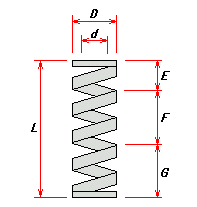 D: Outer diameter of spring
d : Inner diameter of spring
L : Free length of spring (see a catalog by each manufacturer for details).
E. Close length of spring (see a catalog by each manufacturer for details).
F : Stroke
G : Length of shrinkage by weight of ejector plate
K : Spring constant (see a catalog by each manufacturer for details).
Wo :Weight to one spring
W : Total weight of ejector plate
y : Spring quantity
Ví dụ theo thông số lò xo trên catalogue
| Spring Constant ( K ) | Free length ( L ) | Close length ( E ) | max deflection F + G | Outer diameter ( D ) | Inner diameter ( d ) | Price | |
| Spring for High Deflection | 0.73kg/mm | 300mm | 150mm | 150mm | 46mm | 33mm | 500 yen |
| Spring for Light Load | 1.9kg/mm | 300mm | 150mm | 150mm | 60mm | 33mm | 2000 yen |
For example, if a stroke is F = 125mm (a stroke is referred to the stroke to eject parts that is determined during mold design.), the total (deflection amount) of the length of spring stretch and the length of shrinkage by ejector plate’s weight must be more than 125mm.
According to the chart, the maximum deflection amount ( F + G ) is F +G = 150mm, and the free length of the spring is E + F + G, thus L = 300mm can be adopted. Therefore, it must be smaller than the length of shrinkage by the ejector plate : G = L – ( E + F ) = 300 – (125 + 150) = 25mm.
As there are various types of springs, let’s calculate the quantity of the two types of spring that meet the requirements above (the weight of the ejector plate is the same as the calculated weight of ejector plate dealt with in the previous chapter)
|
Spring for High Deflection: From Wo/K |
Spring for Light Load: From Wo/K |
 G,
G,Calculating prices in cases when each spring is used, the price with the spring for high deflection will be lower.
Answer. Use 58 springs of D =46, L =300mm.
|
In selecting springs, it is naturally important to meet design requirements, but it is also important to select with consideration of price, durability, or functionality..
|
Gas Spring Selection Example
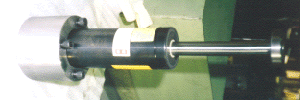
Gas spring may be selected based on assembling or the weight of ejector plate. Normally it is used for a relatively large mold (the weight of ejector plate is over 500 kg according to the in-company standard of a certain company). Generally, 2 to 4 gas springs are used. The heavier a mold is, the more gas springs are used. When many gas springs are used, position them so that the weight is evenly distributed to each gas spring.
Gas spring is categorized into two types:
TB Type
Its outer diameter is Φ75. Installed to a relatively large mold. As the spring constant is small, it is durable.
KG Type Its outer diameter is Φ50. Easy to design as the diameter is small. Installed to a small mold.
Let’s assume four gas springs are used here for an example of calculation. First, calculate the weight of an ejector plate.
Weight of ejector plate A : 1100 * 450 * 40 = 19800000 = 19800
19800 * 7.85 (khối lượng riêng của sắt) = 155430g = 155.4kg
Weight of ejector plate B : 1850 * 450* 100 = 83250000 = 83250
83250 * 7.85 (khối lượng riêng của sắt) = 653512g = 653.5kg
Total weight of ejector plate: W = A + B = 155.4 + 653.5 = 808.9kg
Multiply the calculated weight of ejector plate by 1.3 (safety ratio).
* 1.3 is used as a common safety ratio here.
808.9 * 1.3 = 1051.57kg 1052kg
Calculate the weight put on one spring: 1052kg / 4 = 263kgf
<Example of catalog>
|
Gas spring constant( G )
|
Stroke ( X )
|
Constant ( C )
|
Filling pressure ( P )
|
Load selection range Wo )
|
|
1.95mm
|
200mm
|
467
 |
Min. 50 – Max. 150kgf/
|
235 – 700kgf
|
As the weight put on one spring will be 263kg, KG750 gas spring meets the requirements of load selection range.
| To calculate filling pressure fromP =100 * Wo / C : P = 100 * 263 / 467  56.3 (kgf / ) 56.3 (kgf / )ÁAs filling pressure is used between min. of 50kgf/ and max of 150kgf/,this condition is met. To calculate corresponding spring constant from K= G * P / 100 : K = 1.95 * 56.3 / 100 1.1 (kg/mm)
To calculate displacement from the top dead center. of piston rod from W = P(G * X + C ) / 100 :
W = 56.3 (1.95 * 200 + 467) / 100 482.5 (kgf) |
P : Filling Pressure
Wo : Early load C : Constant (see a catalog by each manufacturer for details). K : Corresponding spring constant G : Gas spring coefficient (see a catalog by each manufacturer) X :Piston rod displacement |